






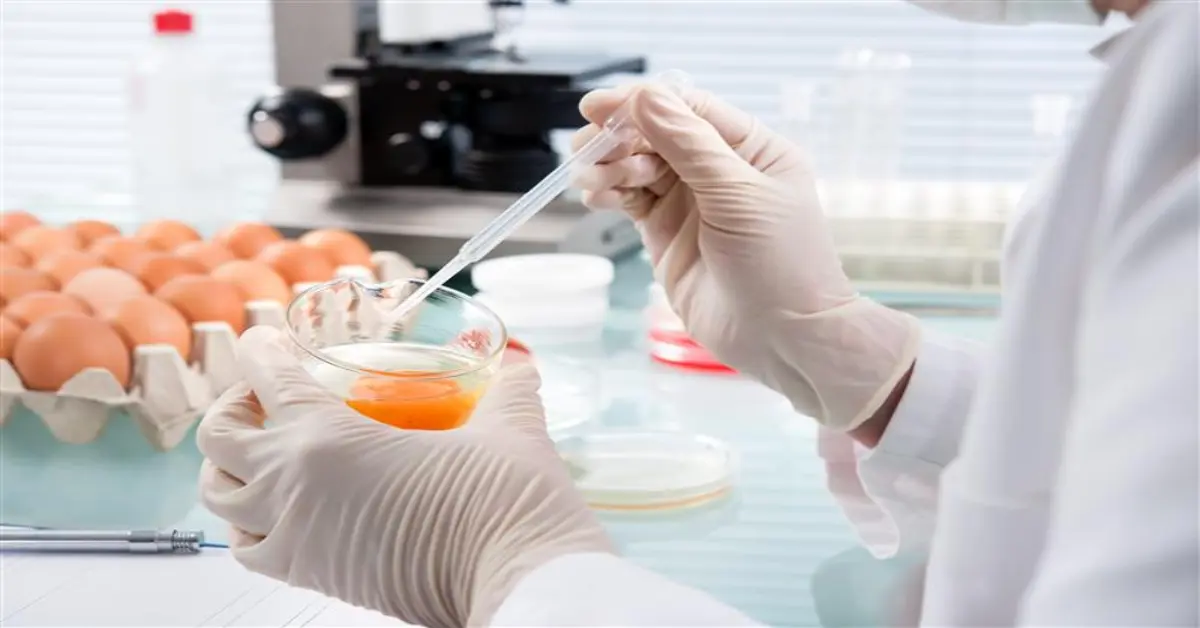
NofaLab receives a record number of PFAS testing requests for eggs, following the warning from RIVM for backyard chicken eggs.
Following a recent warning from the Dutch National Institute for Public Health and the Environment (RIVM) regarding PFAS contamination in backyard chicken eggs, demand for PFAS testing has skyrocketed. Pfastest.nu, a service provided by NofaLab (part of the Cotecna group), offers test kits for individuals who keep hobby chickens. Alarmingly, more than half of the eggs tested so far have been deemed unsuitable for consumption. Supermarket eggs, however, are not considered at risk.
Earlier this week, RIVM advised consumers to avoid eating eggs from backyard chickens due to high PFAS levels, which may pose health risks. Since the publication of this warning, Pfastest.nu has experienced a dramatic surge in test requests.
At NofaLab’s facility in Schiedam, eggs are meticulously analyzed for PFAS contamination. The reception area currently resembles a busy postal center, with hundreds of packages being packed, labeled, and dispatched. "I returned from paternity leave specifically to help manage the demand," says Menno, Customer Service Manager, while labeling sample boxes.
Traditionally focused on testing food products, the laboratory has temporarily become the epicenter of what is being called the "backyard chicken crisis." Last August, NofaLab launched Pfastest.nu as a small side project, offering PFAS testing for eggs, vegetables, fruit, and meat. Normally receiving about ten test requests per week, the lab has now processed nearly one thousand requests within days. "The demand has exploded since the RIVM announcement," says Frank Cobussen, Managing Director of NofaLab.
The RIVM warning stated that backyard chicken eggs across many parts of the Netherlands may contain unsafe PFAS levels. PFAS are associated with potential health risks, including an increased likelihood of cancer and elevated cholesterol levels, although scientific research on the full extent of the effects is still ongoing.
Previously, RIVM had issued localized warnings for the Dordrecht area, where the chemical company Chemours, linked to PFAS emissions, is based. However, recent findings indicate that PFAS contamination is a far more widespread problem in the Netherlands.
PFAS: ubiquitous and persistent
PFAS (per- and polyfluoroalkyl substances) is a collective term for thousands of chemical compounds used in products such as rainwear, firefighting foam, and non-stick cookware. Due to their stability and persistence, PFAS are often referred to as "forever chemicals."
While the exact route of contamination into eggs remains uncertain, RIVM suggests that PFAS may accumulate in earthworms living in contaminated soil. Chickens consuming these worms may subsequently accumulate the chemicals in their bodies.
"For backyard chicken owners, this news has come as a major shock," says Frank Cobussen. "Many believed they were producing healthy, organic eggs, but the reality is that these eggs can be significantly less safe than commercially available supermarket eggs. Naturally, everyone now wants to understand their personal risk as quickly as possible."
Backyard chicken owners can purchase a PFAS testing kit for €125—up from €100 last week, due to increased costs. The kits, made entirely from PFAS-free materials, require the submission of a scrambled egg sample for analysis. NofaLab then extracts and analyzes the PFAS content at its Schiedam laboratory.
A specialized machine, affectionately nicknamed "the beast," determines PFAS concentrations in micrograms per kilogram. The lab focuses on the four most prevalent types of PFAS, including PFOS and PFOA.
Eggs exceeding European safety thresholds are given a red label ("Not suitable for consumption"), a result seen in slightly more than half of the submitted samples.
Eggs with PFAS concentrations below the safety limits receive an orange label, indicating they may be consumed in moderation depending on body weight—typically about two eggs per week for the average adult. Only around 20% of the eggs tested receive a green label, indicating no consumption restrictions.
Commercial poultry farms not affected
RIVM’s advice does not apply to eggs produced by professional poultry farmers. Even free-range farm chickens tend to accumulate less PFAS because they are regularly fed prepared feed and therefore less likely to forage for contaminated worms. As Bart-Jan Oplaat, Chairman of the Dutch Union of Poultry Farmers, explains: "When chickens have full stomachs, they are less inclined to snack on worms."
Moreover, backyard chickens typically live longer than farm chickens, allowing more time for PFAS accumulation in their bodies. It is important to note that the testing results reflect only individual egg samples, which may not represent the contamination levels of an entire flock. Testing typically focuses on a single egg to keep costs manageable.
Looking ahead, Frank Cobussen does not expect this heightened interest in PFAS testing to fade anytime soon. "PFAS is practically everywhere, so there is an ongoing need for testing," he notes.
Recently, NofaLab received approval from its Geneva-based head office to invest in a second high-capacity testing machine—another "beast" to meet the growing demand.
To learn more about PFAS testing or to get a free quote, please contact us
Book a PFAS test from NofaLab CLICK HERE
Learn more about Cotecna PFAS testing services CLICK HERE
About NofaLab
NofaLab provides reliable laboratory testing and analytical services, specializing in food, feed, and industrial applications. With ISO 17025 accreditation (L440), NofaLab delivers accurate, science-based results that support sustainability, regulatory compliance, and operational efficiency. Through expert knowledge and advanced technology, NofaLab helps clients optimize processes, enhance productivity, and meet international quality and safety standards.